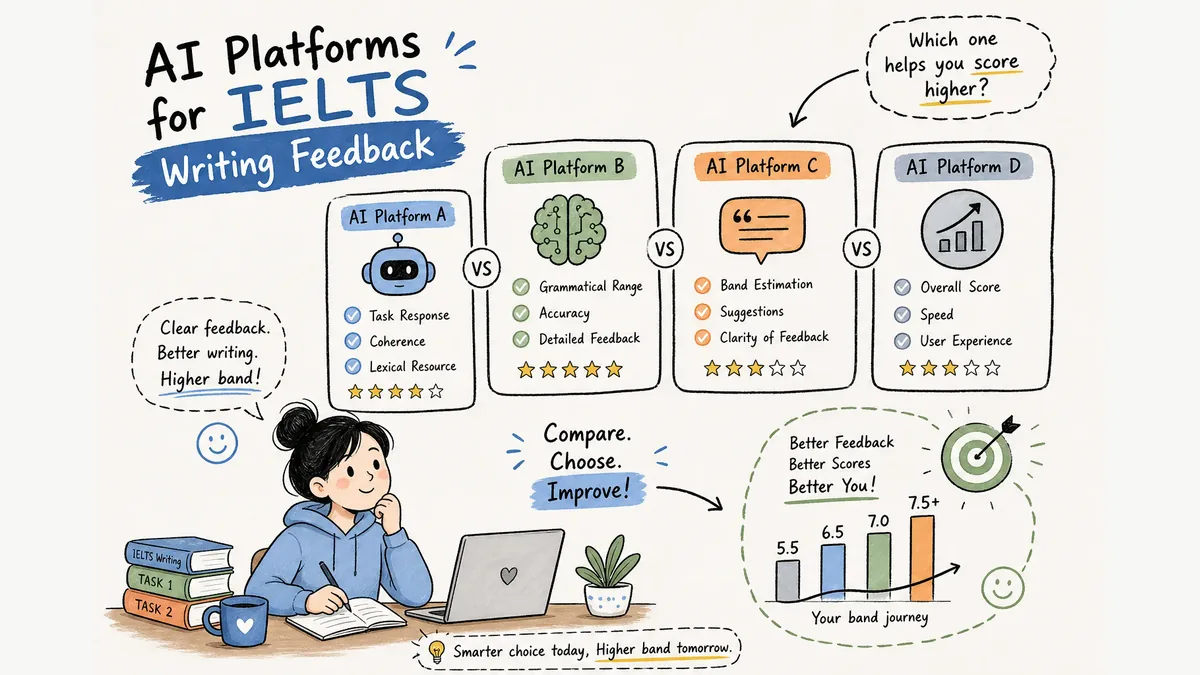
When you compare different AI platforms for IELTS writing feedback, start with a practical question: does the tool explain what in your essay supports its estimate, and does it connect that explanation to the IELTS Writing criteria? An instant band number can be useful as a rough practice signal, but it is not an official IELTS result. AI scores can vary with the model, prompt, sample essays, and scoring method.
This guide compares general-purpose AI assistants and purpose-built IELTS writing checkers by the evidence and features that learners can verify. It focuses on Task 1 and Task 2 coverage, criterion-level feedback, independent scoring studies, and what to check before choosing an AI essay grader. Product features and plans change, so confirm current details on each provider’s site.
Why an AI IELTS writing score can differ from an examiner’s score
AI writing scores should be treated as formative feedback, not a promise of your test-day band. In a 2024 study using Cambridge IELTS essays, GPT-4o’s correlation with examiner scores was 0.71 and its root mean squared error was 1.05 when example essays were included in the prompt. Those results describe that study’s model, prompt, and dataset; they do not establish how every current AI writing checker performs.
A 2026 study compared ChatGPT 5.0 and LexiBot on 74 IELTS Writing Task 2 essays previously assessed by certified examiners. It reported stronger alignment for ChatGPT in that sample and noted that the AI systems tended to assign lower scores. Neither result proves that one platform will be more accurate for every learner or task. The studies are useful reminders to inspect the evidence, methods, and limitations behind a score.
General-purpose language models can produce fluent comments without applying the IELTS descriptors consistently. Purpose-built tools may organize feedback around the rubric, but a rubric-shaped report alone does not prove scoring accuracy. Look for examples, transparent limitations, and independent validation that matches the task you practise.
What to compare in an IELTS writing checker
IELTS Writing is assessed using four criteria: Task Achievement for Task 1 or Task Response for Task 2, Coherence and Cohesion, Lexical Resource, and Grammatical Range and Accuracy. Task 2 carries more weight in the overall Writing score. A useful AI IELTS writing checker should make the task-specific distinction clear instead of treating every essay as the same kind of response.
- Task coverage: Check whether the platform supports your module and the task types you practise. Academic Task 1 includes charts, tables, diagrams, maps, and processes; General Training Task 1 is a letter.
- Criterion-level feedback: See whether it discusses the four criteria separately and points to evidence in your response, rather than returning only one overall IELTS writing band score.
- Actionable corrections: Useful feedback explains why a sentence may be unclear or inaccurate and gives you a chance to revise it in your own words.
- Scoring evidence: Distinguish vendor descriptions from independent studies. Check the sample size, task type, model version, rubric, and error measure before relying on an accuracy claim.
- Practice conditions: Review current limits, privacy terms, and plan details on the provider’s own site. Free access and paid features can change.
Task 1 and Task 2 need different checks
Task 1 and Task 2 use the same broad set of writing criteria, but the first criterion changes: Task Achievement applies to Task 1, while Task Response applies to Task 2. Academic Task 1 also requires you to select and summarize key information from visual data. A tool that gives helpful Task 2 essay comments has not automatically shown that it can assess charts, maps, or process descriptions well.
When comparing platforms, submit one Task 1 response and one Task 2 essay if both matter to your preparation. Check whether the feedback recognizes the task type, identifies relevant evidence, and explains its reasoning. For Task 1, review the feedback on overview, key features, comparisons, and accuracy of reported information. For Task 2, check how it addresses your position, main ideas, development, and support.
AI IELTS writing feedback platforms compared
The table summarizes what the sources linked in this article support. “Not established here” means this comparison does not have enough current, independent evidence to rate that item; it does not mean the platform lacks the feature.
| Platform | What it is | Evidence covered here | What to verify before relying on it |
|---|---|---|---|
| ChatGPT | General-purpose AI assistant | A 2024 GPT-4o study and a 2026 ChatGPT 5.0 study report results for specific IELTS Task 2 samples and methods. | Current model, prompt, task coverage, and whether criterion scores are calibrated for IELTS. |
| Gemini | General-purpose AI assistant | No directly comparable IELTS scoring result is assessed in the studies cited here. | How well your prompt follows the task-specific descriptors; verify scores against trusted feedback. |
| LexiBot | Purpose-built writing assessment platform | Included in a 2026 study of 74 IELTS Task 2 essays; the study reports that ChatGPT aligned more closely in that sample. | Current model and plan details, plus evidence for the task types you need. |
| IELTS Ai Pro | IELTS preparation platform with an AI writing checker | The platform describes its writing feedback as organized around IELTS criteria. This is a vendor feature description, not independent validation of scoring accuracy. | Try a Task 1 and Task 2 response, review the feedback against the official descriptors, and check current access limits. |
| DeepIELTS | IELTS-focused preparation tool | No directly comparable independent scoring result is assessed in the sources cited here. | Current task coverage, the feedback format, pricing, privacy, and any published validation. |
| Engnovate | IELTS preparation and writing practice tool | No directly comparable independent scoring result is assessed in the sources cited here. | Current task coverage, the feedback format, pricing, privacy, and any published validation. |
| IELTS Writing Pro | IELTS writing practice product | No directly comparable independent scoring result is assessed in the sources cited here. | Current task coverage, the feedback format, pricing, privacy, and any published validation. |
This is an evidence-limited comparison, not a controlled head-to-head test of every platform. The 2024 and 2026 studies use different model versions, samples, and methods, so their figures should not be read as a single leaderboard. Before choosing an IELTS essay grader, run the same practice response through the tools you are considering and compare the explanations with the official band descriptors.
Overall band estimate or criterion breakdown?
An overall estimate can show a broad practice trend, but it does not tell you what to work on next. Criterion-level comments can be more useful when they explain which parts of your response meet a descriptor and which need revision. Treat the comments as hypotheses to check, especially for Task Achievement or Task Response and Coherence and Cohesion, where judging relevance and development requires reading the response in context.
For a practical routine, keep the essay prompt with your draft, review each criterion, choose one or two changes, and write a revision. You can also compare that feedback with the advice in our guide to how IELTS Writing band scores are assessed and our article on using AI feedback for IELTS writing practice.
Free plans, prices, and privacy
Plans, usage limits, and trial terms change often. Check the current price and feature list directly with the provider rather than relying on an older comparison or a search snippet. Before pasting personal writing into an AI service, read its privacy policy and check how submitted text may be stored or used.
A free tier can help you try the workflow, but the main question is whether the feedback helps you make a specific improvement. Compare the useful feedback you receive, any usage limits, and the cost of the plan you would actually use. Do not assume that a higher price or a confident-looking band estimate means greater accuracy.
How to choose an AI writing checker for your IELTS goals
If you are building a regular study routine, choose a tool that gives you enough practice opportunities and clear next steps. If Task 1 is a concern, test it with the exact format you need. If you mainly want grammar suggestions or vocabulary ideas, a general AI assistant may be enough, but ask it to explain edits and keep your own meaning. For an IELTS writing band score estimate, look for task-aware, criterion-level reasoning and remember that only the official test reports your exam result.
IELTS Ai Pro provides an AI IELTS writing checker for practice with task-aware feedback. Try a response, compare the comments with the official criteria, and use the result to plan a revision. Its feature descriptions are vendor-stated; use the same evidence standard for IELTS Ai Pro that you use for every platform in this comparison.
Key takeaways
- AI essay scores are practice estimates, not official IELTS results.
- Check Task 1 and Task 2 separately, including the correct Task Achievement or Task Response criterion.
- Prefer feedback that cites evidence in your essay and gives a clear revision step.
- Read independent studies carefully; their findings apply to the models, prompts, tasks, and samples they tested.
- Verify current plan limits, prices, and privacy terms with each provider.
To try structured feedback on your own response, open the IELTS Ai Pro writing checker. Then compare its suggestions with the official IELTS Writing criteria and revise one part of your essay at a time.
Sources
- Qiu, Yan, and Cai (2024), Large Language Models for Second Language English Writing Assessments: An Exploratory Comparison.
- Ho (2026), Exploring the Potential of ChatGPT 5.0 and LexiBot as Automated Essay Scorers for IELTS Writing Task 2.
- IELTS.org, Academic Writing test format and assessment criteria.


