You find the right paragraph, copy a phrase that looks relevant, and move on. During review, the idea seems correct—but the answer is still wrong because the completed sentence is ungrammatical or contains one word too many.
A recent learner described being stuck below 25 correct answers and specifically struggling to choose the exact word for sentence-completion gaps. The repair is not more random scanning. It is a short chain of checks that narrows the answer before you copy it.
The answer must pass three gates at once: it comes from the passage, it completes the meaning, and it fits the grammar and word limit of the question.
Know the official sentence-completion rules
In this question type, you complete each sentence using words from the passage. The instruction gives a word and number limit, which can change between tasks. Writing more than that limit loses the mark. The completed sentences follow the same order as the information in the text.
Official IELTS guidance also notes that hyphenated words such as “check-in” count as one word. Spelling and grammar matter, so an answer cannot be selected only because it sits near a repeated keyword.
Use the four-check decision flow
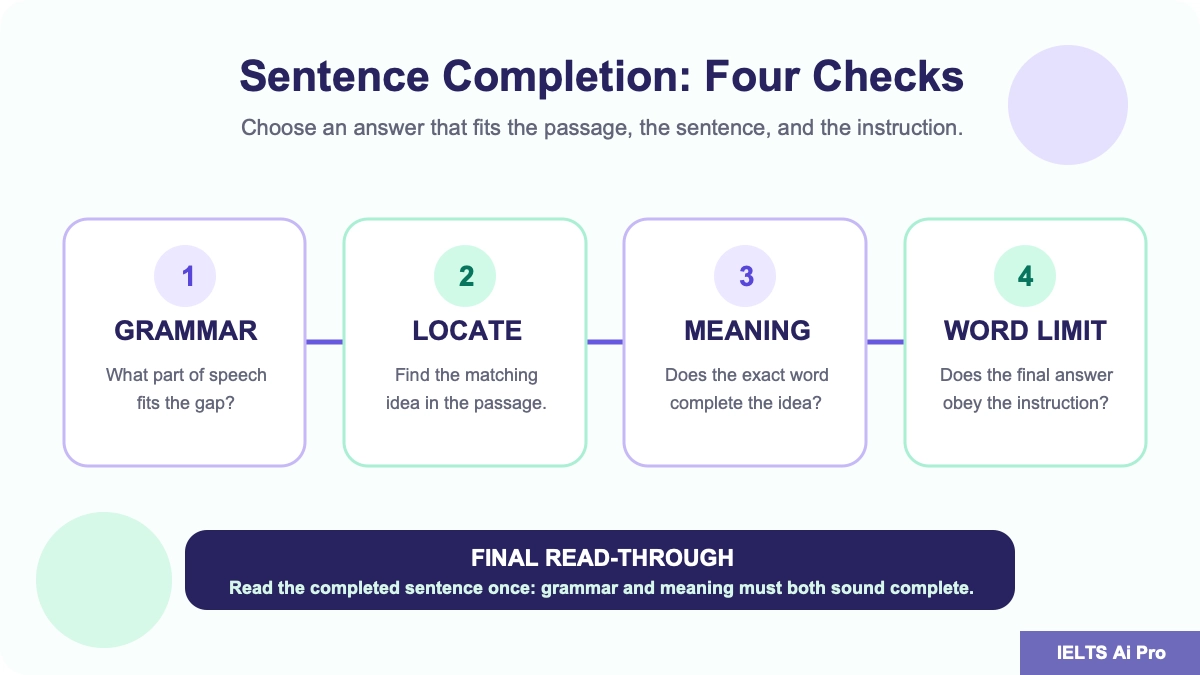
- Grammar: predict what can fit the gap before searching—noun, verb, adjective, number, or short phrase.
- Locate: find the passage sentence that expresses the same idea, remembering that the wording will often be paraphrased.
- Meaning: compare the complete question sentence with the passage, not just one matching keyword.
- Word limit: count the final words and numbers exactly, then read the completed sentence once.
Predict the gap before you scan
| Words around the gap | Likely answer type | What to check |
|---|---|---|
| “a ___” | Singular countable noun or adjective + noun | Does the article agree with the answer? |
| “many ___” | Plural countable noun | Is the plural ending part of the passage word? |
| “to ___” | Base-form verb | Does the passage use the exact verb after paraphrasing? |
| “is extremely ___” | Adjective | Have you copied an adjective rather than a noun? |
| “in ___” | Time, place, year, or noun phrase | Does the preposition create the correct meaning? |
This prediction is not the answer. It is a filter. If the gap needs a plural noun, you can reject a nearby singular verb even when it shares the question’s keyword.
Match the idea, not the repeated word
Original practice passage: “Because the wetland stores heavy rainfall, villages downstream experience fewer sudden floods.”
Question: “The wetland reduces the risk of abrupt flooding in ___.”
The repeated idea is not built from identical wording: “stores heavy rainfall” explains why flood risk falls, “villages downstream” is the affected place, and “sudden” becomes “abrupt.” If the instruction says NO MORE THAN TWO WORDS, the exact answer is villages downstream.
“Heavy rainfall” is a tempting phrase because it sounds important, but it completes the wrong meaning. Read the entire sentence after inserting the candidate answer.
Use question order to control the search area
Sentence-completion answers appear in passage order. Once you confirm answer 18 in the second half of a paragraph, answer 19 should appear after that evidence. Keep a light mental boundary: start from the previous answer and stop when you reach evidence for the next confirmed answer.
This prevents restarting from line one for every gap. It also reduces the risk of copying a similar fact from an earlier paragraph that no longer matches the question sequence.
Handle word limits without guessing
| Instruction | Allowed examples | Not allowed |
|---|---|---|
| ONE WORD ONLY | forest | the forest |
| NO MORE THAN TWO WORDS | coastal forest | the coastal forest |
| NO MORE THAN TWO WORDS AND/OR A NUMBER | 12 months; about 12 | approximately twelve full months |
| Hyphenated word | check-in counts as one | Adding extra words because the hyphen was miscounted |
Do not add an article, change a word form, or supply your own synonym unless the task format explicitly permits a choice from a list. For passage-word completion, use the exact words that fit.
Diagnose the real error
| Wrong-answer pattern | Likely cause | Repair drill |
|---|---|---|
| Right paragraph, wrong word | Keyword matching without full-sentence meaning | Underline the question subject and result before scanning |
| Meaning right, grammar wrong | No gap-type prediction | Label five gaps by part of speech before reading |
| Correct phrase, mark lost | Word-limit or spelling failure | Run a final count-and-spell pass |
| Search takes too long | Restarting from the beginning | Use the previous answer as the next starting boundary |
Practise with an evidence log
- Copy the question with the gap.
- Write your predicted answer type.
- Record the exact passage words that prove the answer.
- Note the paraphrase connecting question and passage.
- Classify any error as grammar, location, meaning, spelling, or word limit.
After ten questions, count the categories. The largest category—not the overall score—shows what to practise next.
Final action: run the four checks under time
Open the IELTS Ai Pro Reading practice area, complete one sentence-completion set, and record the evidence for every uncertain answer. Use the paraphrase-trap guide when the right paragraph still produces the wrong choice and the Reading error-log method to track repeated decision failures.
Question-order, word-limit, spelling, grammar, and hyphenation claims were checked on 25 July 2026 against the official IELTS Academic Reading format.