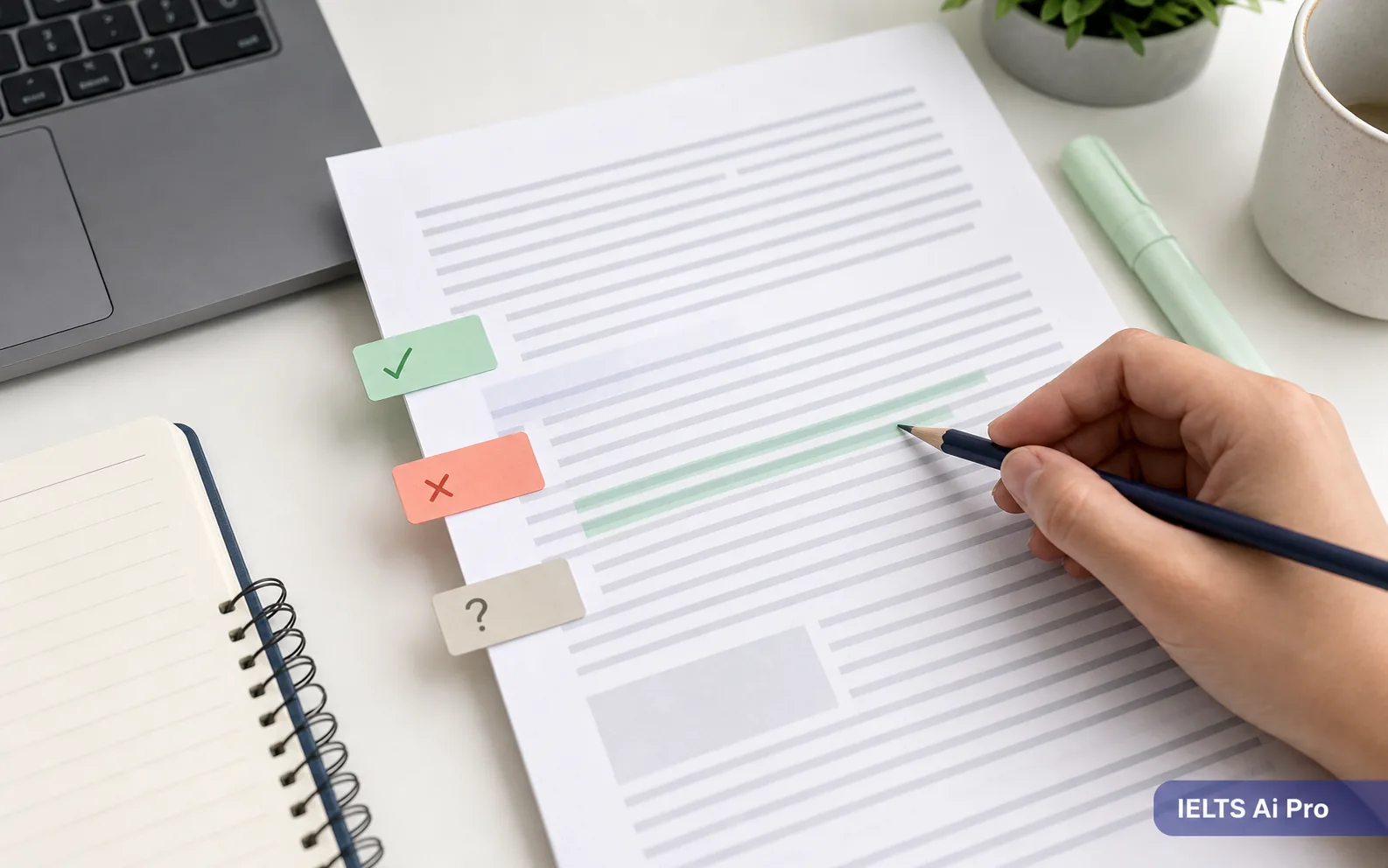
True, False, Not Given questions test whether a statement matches the passage—not whether it sounds reasonable or whether you already know the topic. The fastest way to improve is to replace intuition with a strict evidence decision.
Know the three decisions
- True: the passage expresses the same meaning as the statement.
- False: the passage clearly contradicts the statement.
- Not Given: the passage does not provide enough information to prove or disprove the statement.
False requires contrary evidence. If the passage simply stays silent about one important part of the statement, the answer is Not Given.
Step 1: reduce the statement
Underline the subject, the main claim, and limiting words such as all, only, always, mainly, first, or more than. These small words often control the answer. “Some researchers supported the plan” is not equivalent to “all researchers supported the plan.”
Step 2: predict paraphrases
The passage rarely repeats the statement word for word. Before scanning, think of likely equivalents. “A decline in attendance” might appear as “fewer people visited.” “Was prohibited” might appear as “was no longer permitted.” This keeps you searching for meaning rather than identical vocabulary.
Step 3: find the evidence zone
These questions usually follow passage order. Use names, dates, technical terms, or unusual nouns to locate the relevant sentence, then read one sentence before and after it. The answer may depend on a pronoun, contrast, or qualification outside the sentence containing your keyword.
Step 4: run the evidence test
Ask three questions in order:
- Does the passage support every essential part of the statement? Choose True.
- Does the passage state the opposite of an essential part? Choose False.
- Is an essential part missing or impossible to verify? Choose Not Given.
Do not turn “the passage does not say this” into False. Missing evidence is exactly what Not Given means.
The decision table: support, contradiction, or silence?
| What the passage provides | Decision | Question to ask |
|---|---|---|
| The same claim in different words | True | Does every essential part match? |
| A clear opposite claim | False | Can I underline the contradiction? |
| No proof for one essential detail | Not Given | Am I adding information the writer never supplied? |
Mini example: if the passage says a museum opened in 1998 and the statement says it was popular immediately, the opening date is confirmed but immediate popularity is not. Unless another sentence discusses popularity, the answer is Not Given.
Common traps
Reversed comparisons: the passage says A is larger than B, while the statement says B is larger than A. That is False. Extra details: the passage confirms an event but never confirms its cause; a statement that adds the cause is Not Given. Partial matches: most words match but one limit changes the meaning. Outside knowledge: a fact may be scientifically true but still Not Given if the passage does not provide it.
Use a two-pass timing strategy
On the first pass, answer items with direct evidence and mark uncertain ones. On the second, compare only the exact statement with the evidence zone. Do not reread the entire passage for every question. If you still cannot identify either support or contradiction, Not Given may be appropriate—but make that choice from the evidence, not frustration.
Practise the decision, not just the score
After a timed set, record why each error occurred: missed paraphrase, ignored limiting word, confused contradiction with missing information, or searched the wrong paragraph. Start an IELTS Reading practice test and use the answer review to find the pattern. You can also explore the free IELTS practice test guide before attempting a longer mock test.