
The Task 1 page loads and there is no line graph, no bar chart, and no useful set of numbers to compare. Instead, arrows move through a factory, a life cycle, or a system. You can see every stage, yet the first sentence still feels harder than it should.
Process diagrams reward a different decision from chart tasks. You are not searching for the highest figure. You are showing how a sequence begins, develops, and ends. Once that shape is clear, the report becomes much easier to control.
Do not write one sentence for every box immediately. Map the whole process first, then turn the map into an overview and two logical stage groups.
What an IELTS process diagram asks you to do
In Academic Writing Task 1, a diagram may show the stages of a process, how something works, or how an object or event develops. You need to describe, summarise, or explain the visual in your own words and write at least 150 words. A practical target is about 20 minutes so Task 2 still receives the larger share of your Writing time.
Process tasks usually fall into two useful planning types:
| Process type | What to notice | Typical language choice |
|---|---|---|
| Linear | A clear starting material or event and a final result | Sequence links and often passive verbs for manufactured stages |
| Cyclical | The final stage returns to or creates the next beginning | Cycle language and active verbs when natural agents perform actions |
| How something works | Inputs, components, movement, and output | Cause-and-effect links plus precise functional verbs |
Use the four-move planning flow
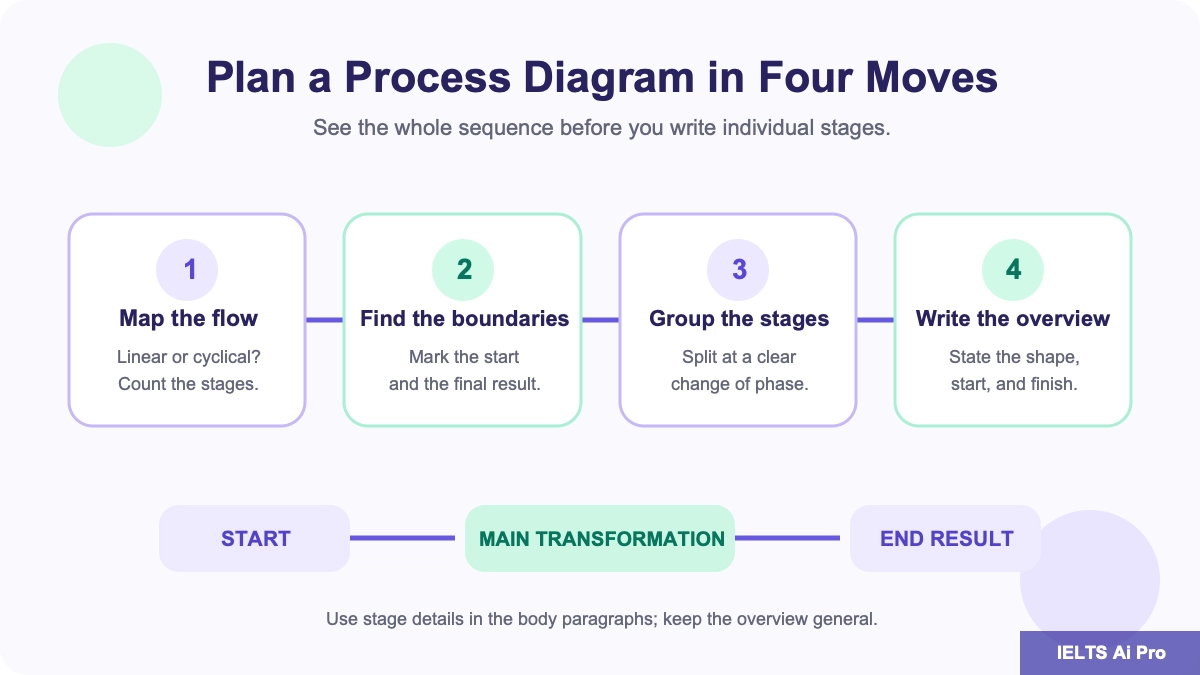
The visual is a planning order, not a paragraph template. Complete these decisions on the question screen or your notes before you start drafting:
- Map the flow: decide whether it is linear, cyclical, or functional and count the stages.
- Find the boundaries: mark the first input or event and the final output or return point.
- Group the stages: split the sequence where the material, location, agent, or phase changes clearly.
- Write the overview: state the overall shape and the main beginning-to-end transformation without listing every detail.
Build an overview without data
Imagine a diagram showing discarded glass becoming new bottles through collection, sorting, crushing, melting, shaping, and cooling. A weak overview repeats isolated boxes: “First glass is collected, then it is sorted, then it is crushed.” That is body-paragraph detail.
A stronger overview identifies the shape and transformation: “Overall, this is a linear recycling process in which used glass is prepared and melted before being formed and cooled into new bottles.” It gives the reader the start, the main change, and the result.
| Overview ingredient | Question to ask | Glass example |
|---|---|---|
| Shape | Linear or cyclical? | Linear recycling process |
| Start | What enters first? | Used glass |
| Main transformation | What major change happens? | Preparation and melting |
| End | What final result appears? | New bottles |
Choose the body-paragraph split
Do not automatically divide the number of boxes in half. Split where the process itself changes. In the glass example, Body 1 could cover collection through crushing because these stages prepare the material. Body 2 could cover melting through cooling because these stages create the new product.
For a natural cycle, a clear change of phase works well: egg to juvenile in one paragraph, then adult development and reproduction in the next. For a machine, group components by function: input and control first, movement and output second.
Use passive voice only when it fits
| Diagram event | Natural sentence | Why it works |
|---|---|---|
| Workers sort bottles | The bottles are sorted by colour. | The material matters more than the unnamed worker |
| Heat melts crushed glass | The crushed glass is melted in a furnace. | The focus stays on the transformation |
| A larva develops | The larva develops into an adult. | The natural agent performs the action |
| Water returns to the atmosphere | Water evaporates and rises. | An active verb is clearer than forced passive grammar |
A process report is not a passive-voice competition. Use passive forms when the doer is unknown or unimportant; use active forms when the diagram clearly shows a natural agent or component doing the action.
Control sequence language
Use links to show order, not to decorate every sentence. “Initially,” “after this,” “once the material has been…,” and “in the final stage” are useful when the relationship needs to be explicit. Repeating “then” eight times makes the sequence feel mechanical.
You can also connect stages through grammar: “After being crushed, the glass is transferred to a furnace.” This shows the relationship without starting another sentence with a memorised connector.
Run the seven-point process check
- Did I identify the correct process type?
- Did I state the start and final result in the overview?
- Did I group stages at a meaningful change?
- Did I include every important stage once?
- Did I avoid opinions, causes, or benefits not shown in the diagram?
- Did I use active and passive verbs naturally?
- Did I reach at least 150 words without copying the prompt?
Final action: plan before you write
Open the IELTS Ai Pro Writing practice area, choose one Academic Task 1 diagram, and spend three minutes completing the four-move flow before writing. Use the Task 1 overview guide to test your summary and the 20-minute Task 1 workflow to protect your timing.
Format and response guidance were checked on 25 July 2026 against official IELTS information on Academic sample tasks and preparing for Academic Writing Task 1.