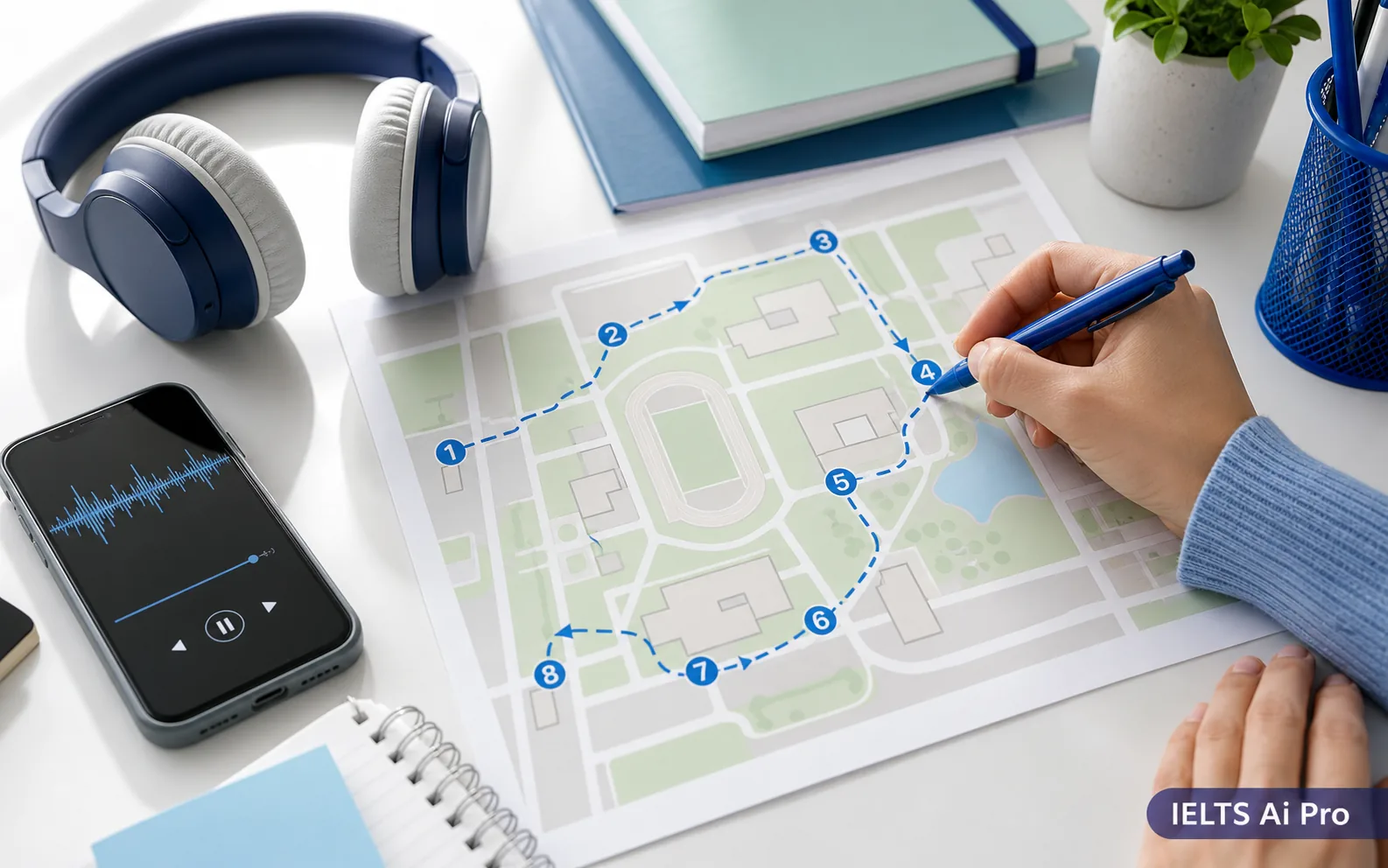
Map and plan labelling questions can feel overwhelming because you must listen, follow a route, interpret spatial language, and write an answer at the same time. The task becomes manageable when you separate it into three actions: predict before the audio, track the speaker’s position, and answer only when the location is confirmed.
Read the visual before the recording starts
Use the preparation time to find the title, entrance, compass, numbered gaps, fixed labels, and any obvious route. Decide whether you are looking at an outdoor map, a building plan, or a site layout. Fixed labels are anchors: they help you recover if you temporarily lose the route.
Predict the type of answer
Look at the answer instructions and the space around each gap. Is the missing item likely to be a room, facility, natural feature, or service? If there is a list of options, scan the nouns and notice similar choices. Prediction reduces the number of possible answers you must evaluate while listening.
Know the language of movement and position
Common route phrases include go past, continue straight, turn left, at the end of, and take the second path. Position phrases include opposite, next to, between, in the corner, just beyond, and on your right. Learn these as relationships on a page, not isolated vocabulary.
Keep your finger or cursor on the route
Start at the entrance or location the speaker names. Move through the map with every direction phrase, even when no answer is required. If you stop tracking after one answer, the next number can arrive while you are still searching the wrong area.
The most important skill is knowing where the speaker is now. An answer option is useful only after its location is confirmed.
Expect corrections and distractors
The speaker may mention a familiar landmark before the answer or correct an earlier plan: “We originally considered the room beside reception, but the workshop will now be opposite the café.” The first location is a distractor. Listen for contrast markers such as but, however, instead, and rather than.
Recover without chasing missed audio
If you lose one answer, do not mentally replay it while the recording continues. Move to the next numbered gap and use a fixed label to relocate. One missed item is cheaper than losing three because your attention stayed in the past.
Check the answer form
At the end, verify the word limit, spelling, and whether you copied the exact option letter or word required. Singular and plural forms can matter. If the task uses a choice list, make sure you have transferred the label requested by the instructions rather than a descriptive word from the map.
Route language you should visualise
| Audio phrase | Action on the map | Common trap |
|---|---|---|
| Go past / just beyond | Move beyond the landmark before stopping | Choosing the landmark itself |
| Opposite / across from | Look on the other side of a path or room | Confusing it with next to |
| At the end of | Follow the route to its final point | Stopping at the first junction |
| Originally … but now | Reject the first location and track the correction | Writing the distractor |
A ten-minute drill
- Study a blank map for thirty seconds and describe the route aloud.
- List five direction phrases you expect to hear.
- Complete the section once under test conditions.
- Replay while tracing the route, pausing after every direction phrase.
- Write down the exact phrase that caused each mistake.
Use the IELTS Listening practice area to apply the drill to timed materials, then review answer-level performance before starting another set. For a broader test workflow, open the IELTS mock test guide.