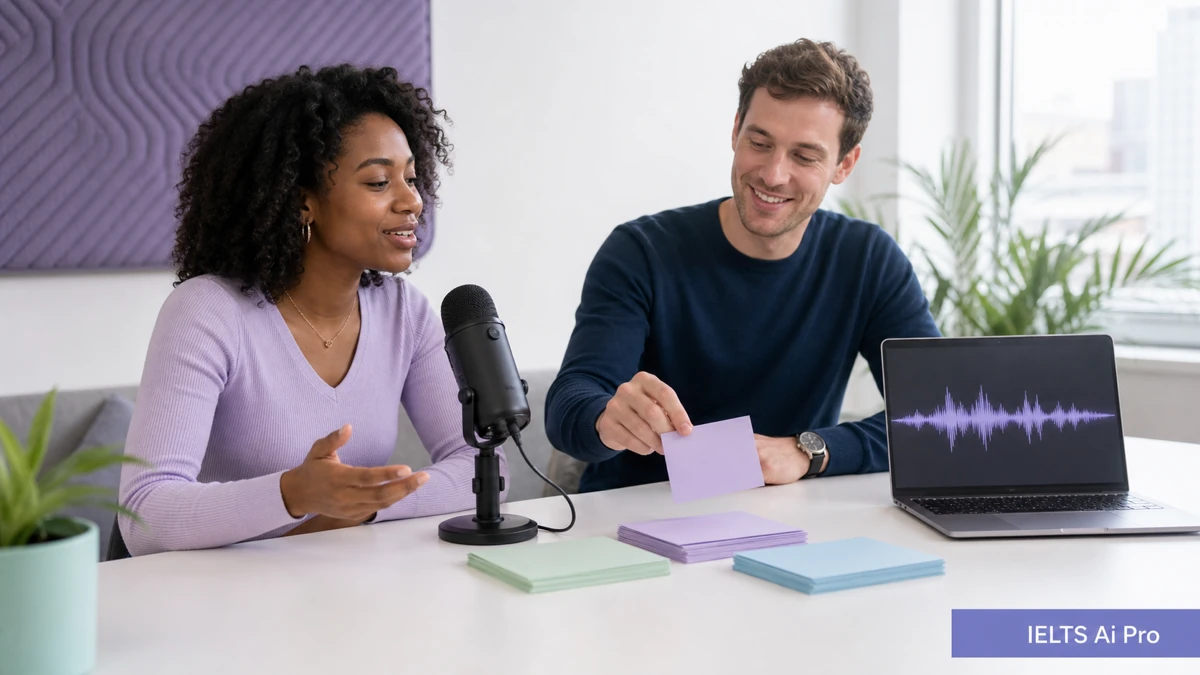
For IELTS Speaking test practice without memorised answers, train the decision process instead of a script. Use unpredictable prompts, choose a simple point quickly, record a natural answer, diagnose one weakness, and answer a related question again with a different example.
You may prepare useful language and answer shapes. The skill is adapting them to the question you actually hear.
Memorise flexible tools, not complete speeches: a way to choose a point, extend it, paraphrase, and recover.
Why can memorised answers make Speaking practice fragile?
A script works only while the question matches it. A small change in tense, subject, or angle can make a prepared speech irrelevant, and searching for the stored answer can interrupt real communication.
The official IELTS Academic sample-question collection gives learners test-style prompts to practise without pre-writing a fixed response. Treat each prompt as a fresh communication task, not a cue for retrieving a script.
What can you prepare without learning a script?
| Prepare this | How it helps | Do not turn it into |
|---|---|---|
| Personal story bank | Gives you flexible examples from work, study, family, places, and decisions | One story forced into every cue card |
| Answer frames | Helps you start, explain, compare, or qualify | Identical sentence sequences |
| Topic vocabulary | Makes familiar ideas more precise | A list of “advanced” words inserted unnaturally |
| Paraphrase moves | Lets you explain a missing word | A memorised definition for every topic |
| Recovery language | Creates a brief, honest thinking space | A chain of fillers before each answer |
How do you answer an unexpected question quickly?
Use CHOOSE–BUILD–SHIFT:
| Move | What to do | Example |
|---|---|---|
| CHOOSE | Select the simplest honest answer you can support | “I prefer small local shops.” |
| BUILD | Add one reason and one concrete detail | “The owners know the area, so they often suggest practical alternatives.” |
| SHIFT | Paraphrase, compare, or qualify if you need more language | “That said, supermarkets are more convenient for a weekly shop.” |
This is a decision frame, not a fixed response. On another topic, the same moves could produce a personal memory, a cause-and-effect explanation, or a balanced opinion.
What does flexible practice look like across Parts 1, 2, and 3?
| Part | Practice constraint | Review focus |
|---|---|---|
| Part 1 | Answer directly, then add one reason or detail | Natural extension without rambling |
| Part 2 | Use one minute to make a four-point route, not full sentences | Story movement and topic coverage |
| Part 3 | Give a position, reason, example, and qualification when useful | Clear development of an abstract idea |
Question length changes, but the principle stays the same: respond to this prompt with language you control.
How should you use random prompts?
- Mix familiar and uncomfortable topics in one list.
- Hide the next question until you are ready to answer.
- Allow three seconds to choose a point for Part 1 or Part 3.
- Record one uninterrupted attempt.
- Change the angle and answer again: past to future, personal to social, or benefit to drawback.
The second question is the flexibility check. If your language bank is reusable, you can adapt without repeating the same content.
How do you review a recording without chasing perfection?
The official IELTS Speaking test format explains that Fluency and Coherence includes speaking at a normal speed without excessive hesitation and using alternative vocabulary when a word is unavailable. The public IELTS Speaking band descriptors also distinguish content-planning hesitation from repeated searching for language.
| Listen for | Diagnostic question | One-change repeat |
|---|---|---|
| Long language-search pauses | Was I missing an idea or a word? | Paraphrase the missing word instead of stopping |
| Repetition | Did I repeat because the point was unclear? | State the point once, then give a detail |
| Forced vocabulary | Would I use this word in a real conversation? | Replace it with a precise familiar choice |
| Flat development | Did I give a reason, example, result, or comparison? | Add one development move |
| Grammar breakdown | Which repeated structure caused the problem? | Use a safer sentence, then rebuild complexity |
Should you repeat the same Speaking question?
Yes, when the repeat has one defined purpose. Repeating can build control, but reciting the polished version until it becomes fixed is less useful. Change one variable on the third attempt so the answer stays flexible.
- Attempt 1: answer naturally and record the baseline.
- Attempt 2: improve one pattern, such as clearer development.
- Attempt 3: answer a related question with a different example.
Use the same feedback loop for Writing with the focused rewrite method: diagnose one pattern, make one deliberate change, then test transfer.
How do you build a flexible language bank?
| Function | Flexible starter | Variation task |
|---|---|---|
| Give a reason | “The main reason is…” | Replace with a personal cause, practical cause, or social cause |
| Qualify | “That depends largely on…” | Change the condition |
| Give an example | “A simple example would be…” | Use a real, community, or hypothetical case |
| Paraphrase | “I cannot recall the exact term, but it is…” | Explain function, appearance, or result |
| Compare | “Compared with…, it tends to…” | Switch the time, group, or place |
Keep the function and vary the content. That is controlled flexibility, not a script.
Final action: record a three-question flexibility set
Open the IELTS Ai Pro Speaking practice area and record three unseen questions: one personal, one story-based, and one abstract. Repeat only the weakest answer with one improvement, then change the question angle. Use the AI Speaking feedback safety guide to separate practice patterns from an official score, and the Part 3 answer-control method when an abstract response drifts.


